

Gustave Roussy and The Lancet launch an international lecture series on innovations transforming cancer care
The inaugural lecture in the “Lecture Series on Cancer Breakthroughs” will take place on Friday 18 September at 5:00 pm. It will be delivered by Professor Timothy R. Rebbeck, a leading cancer prevention specialist at Harvard University and the Dana-Farber Cancer Institute.
► Registration is now open for those wishing to attend either in person in Villejuif or online.
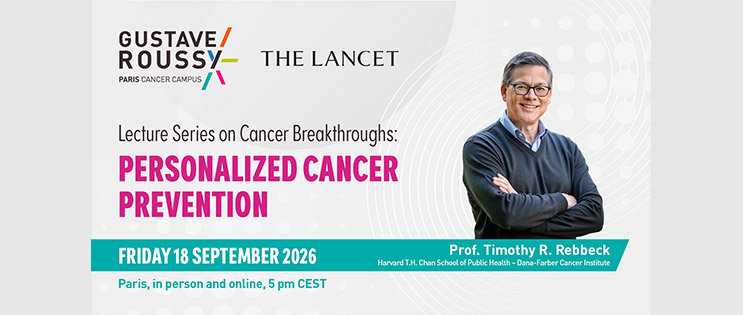
Gustave Roussy and The Lancet have partnered to create the Lecture Series on Cancer Breakthroughs, a new programme of lectures dedicated to major advances in the fight against cancer. This annual event aims to bring together leading research, innovation and public health perspectives around the developments that are reshaping oncology.
The inaugural lecture of this partnership will take place on Friday 18 September at 5:00 pm in Villejuif. It will be delivered by Professor Timothy R. Rebbeck, an internationally renowned epidemiologist and specialist in personalised cancer prevention. Holder of the Vincent L. Gregory Chair in Cancer Prevention at the Harvard T.H. Chan School of Public Health and the Dana-Farber Cancer Institute, Professor Rebbeck’s work is helping to redefine prevention strategies in the era of precision medicine and has led to major advances in several fields, including:
- Improving our understanding of cancer risks associated with BRCA gene mutations.
- Demonstrating the effectiveness of preventive surgery for patients with a high genetic risk of cancer.
- Investigating inequalities in prostate cancer risk and outcomes.
Programme
- 5:00 pm. Introduction
- Vania Wisdom, The Lancet, United Kingdom.
- 5:10. Lecture by Professor Timothy R. Rebbeck - Harvard T.H. Chan School of Public Health & Dana-Farber Cancer Institute, United States.
- 5:55 pm. Panel discussion
- Professor Timothy R. Rebbeck, Harvard T.H. Chan School of Public Health & Dana-Farber Cancer Institute, United States.
- Dr Judith Balmaña, Vall d’Hebron Institute of Oncology, Spain.
- Dr Suzette Delaloge, Institut national du cancer and Gustave Roussy, France.
- 6:40 pm. Q&A
- 7:00 pm. Closing remarks
- Vania Wisdom, The Lancet, United Kingdom.
Professor Fabrice Barlesi, Gustave Roussy, France.
A lecture exploring different aspects of cancer prevention
Professor Rebbeck’s lecture on 18 September will explore how advances in precision medicine are transforming the way cancer is approached.
For many years, efforts to combat cancer focused primarily on diagnosis and treatment once the disease developed. Today, by analysing genetic data, lifestyle factors, and environmental exposures, scientists can increasingly identify individuals at highest risk of developing certain cancers and intervene earlier, sometimes even before the first signs of disease appear.
The lecture will be followed by a panel discussion featuring, among others, Dr Judith Balmaña from the Vall d’Hebron Institute of Oncology (VHIO) in Barcelona. An expert in inherited cancer predisposition, particularly breast and ovarian cancers associated with the BRCA1 and BRCA2 genes, her research focuses on the interpretation of genetic variants, PARP inhibitors, and Lynch syndrome. She has also contributed to several European clinical practice guidelines in the field of cancer genetics.
Practical Information
- Lecture Series on Cancer Breakthroughs: Personalized Cancer Prevention.
- Friday 18 September, 5:00 pm.
- Online and in person at 125 Rue Édouard Vaillant, 94800 Villejuif, France.
- Attendance is free of charge, but registration is required via the dedicated platform.