

A landmark review on myeloproliferative neoplasms published in the New England Journal of Medicine
Researcher Isabelle Plo and Dr William Vainchenker, a haematologist and researcher at Gustave Roussy, have co-authored a landmark review on myeloproliferative neoplasms (MPNs), published in the New England Journal of Medicine on 19 August. The article summarises major advances in understanding these blood cancers and highlights therapeutic prospects that could transform their management in the years ahead.

Blood cancers that can develop over decades
Myeloproliferative neoplasms (MPNs) encompass several bone marrow disorders. They are characterised by the excessive production of blood cells and can expose patients to serious complications, including thrombosis, bleeding or progression to acute leukaemia.
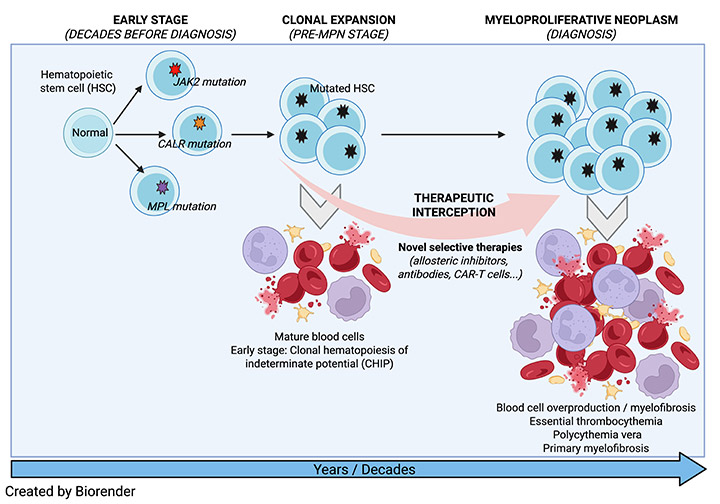
One of the major findings of recent years is that the mutations responsible for these diseases may arise several decades before diagnosis. MPNs therefore provide a unique model for understanding the earliest stages of cancer development and identifying opportunities for early intervention.
New therapeutic hopes
Although current treatments can effectively control the disease and reduce the risk of complications, in most cases they remain unable to achieve lasting elimination of the cells that cause it. However, the authors highlight the emergence of particularly promising new therapeutic strategies. Treatments specifically targeting mutated JAK2 or CALR proteins are currently being developed and could ultimately alter the course of the disease in a lasting way, or even eradicate the tumour clone responsible.
Deciphering the mechanisms behind cancer development
Beyond MPNs themselves, the review highlights the contribution these diseases make to cancer research as a whole. Because they develop slowly and their genetic alterations are now well characterised, they provide a model for studying how cancer arises and evolves over several decades.
This work paves the way for a better understanding of the mechanisms of tumour transformation and for the design of strategies capable of intercepting disease before cancer develops. This approach is fully aligned with Gustave Roussy's ambitions in precision medicine and cancer interception.
International recognition of Gustave Roussy's expertise
This publication reflects the longstanding contribution of Gustave Roussy teams to understanding the biological mechanisms underlying these diseases, particularly mutations in the JAK2 gene, which have profoundly transformed diagnosis and patient management.
Reference
Plo I., Vainchenker W. Myeloproliferative Neoplasms. New England Journal of Medicine, 20 August 2026: https://www.nejm.org/doi/pdf/10.1056/NEJMra2507867